


What is EBITTDA?
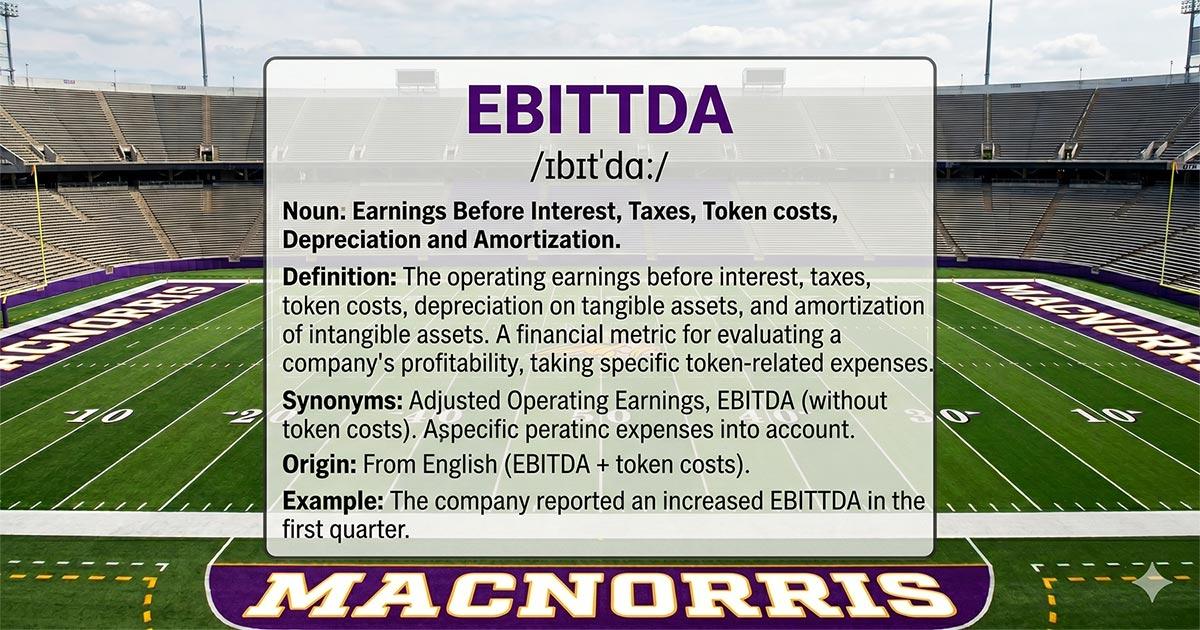
EBITTDA stands for Earnings Before Interest, Taxes, Token costs, Depreciation and Amortization. The term extends the familiar EBITDA with a new cost category: token costs for AI usage. Companies running AI systems like ChatGPT, Claude or Gemini in their operations generate usage-based costs that are not yet accounted for in traditional budget planning. The result: uncontrolled AI spending that hits the margin directly.
EBITDA is familiar to anyone who has sat in a finance meeting. Earnings Before Interest, Taxes, Depreciation and Amortization. The metric that shows how profitable a company is in its core business before financing structure and accounting tricks come into play.
Now there is a new term making the rounds in tech and finance circles: EBITTDA. An extra T for Token. Earnings Before Interest, Taxes, Token costs, Depreciation and Amortization.
Sounds like a joke. It's not.
What are tokens?
When an employee asks ChatGPT, Claude or Gemini a question, the model processes the request in tokens. One token equals roughly four characters of text. A short request costs a few dozen tokens, a complex analysis with long context quickly several thousand.
Barely noticeable for a single conversation. Scaled across hundreds of employees, thousands of requests daily, over weeks and months, amounts arise that were in no original budget plan.
When the limit is missing: $500 million in one month
Companies that unlock AI systems for all employees because they believe in productivity gains are thinking in the right direction. The problem arises when no spending limit is set.
The most well-known example: according to an Axios report, a company whose identity remains unknown spent $500 million on Claude AI in a single month simply because no usage limits were configured. No malicious intent. No abusive use. Just no lid on the pot. Source: Android Authority (opens in new tab)
Anthropic offers enterprise controls with admin dashboards, per-user limits and compliance tools. These must be actively configured, however. In this case, they were not.
More real cases
This is not an isolated incident. The list keeps growing:
- Peter Steinberger, founder of OpenClaw and now an OpenAI employee, publicly announced that his three-person team spent over $1.3 million in a single month on tokens while running a suite of agentic AI tools. Source: Tom's Hardware (opens in new tab)
- Uber's new COO Andrew Macdonald publicly stated that the company burned through its entire 2026 AI budget in just four months. Token costs did not justify the productivity gains.
- Microsoft significantly reduced internal Claude Code licenses after usage costs exploded. Individual engineers were generating between $500 and $2,000 in monthly AI costs per person. Source: Tech Startups (opens in new tab)
- Meta introduced internal leaderboards ranking employees by token consumption to encourage AI usage. The result: mass uncontrolled usage now known as "tokenmaxxing". Source: Tom's Hardware (opens in new tab)
- And the overall picture: according to Ramp economist Ara Khazarian, the average business is spending 13x more on AI tokens than in January 2025. Source: Derek Thompson (opens in new tab)
The most common mistakes
Token costs without limits are just one of many places where AI spending grows uncontrolled. Here are the most common mistakes we see:
- Poorly configured systems with open access
API endpoints that are publicly reachable or run internally without authentication. Every call costs. If nobody controls who accesses them and how often, the meter runs unchecked. - Poorly built agents burning unnecessary tokens
An agent that sends the entire conversation history with every request even though only a small part is relevant. Or one that makes five API calls where one would have sufficed. Poor prompt design multiplies with every invocation. - Missing strategy and poorly trained employees
Employees who do not know how to prompt efficiently write long unstructured requests that make the model restart multiple times. That costs money, and often produces worse results than a precisely formulated question. - Treating AI like a flat-fee SaaS
Many companies planned AI tools in 2024 and 2025 like regular software subscriptions. They underestimated how dramatically usage-based pricing scales with model choice, context length and autonomous agents. - Not engaging with AI at all
The other extreme: companies that ignore the topic entirely while competitors automate processes. Token costs do not arise here, but the opportunity costs grow every month. - Waiting until the technology is ready
The technology will never be finished. Those who wait lose the learning advantage and buy in under twice the pressure two years from now.
What this means for business management
EBITTDA is not yet an official standard. But the discussion behind it is real: AI token costs are operational, recurring and scale with usage. They belong in every serious budget plan, just as cloud costs did ten years ago.
Anyone planning an AI rollout today without setting token budgets, spending limits and monitoring is planning incompletely.
What to do concretely
- Set spending limits at platform level and per team. Most providers offer this natively, it just needs to be actively configured.
- Monitor usage: who uses how much, for which tasks, with what result.
- Train prompt quality: a well-built prompt costs less and delivers better results than three poor ones.
- Regularly check agents and automations for token efficiency, especially when they run frequently.
- Track AI spending as its own cost category, not buried in miscellaneous IT.
- Use cheaper models for routine tasks. Not every simple request needs the most powerful model (there are also great open source models)
EBITTDA is a joke that is not one. Token costs are real, they scale fast, and they surprise CFOs who did not see them coming.
Taking AI seriously means taking the costs seriously. Not to use less, but to use smart.
— Robert

