
What is an MVP? Meaning, Examples, Mistakes
What is an MVP? Meaning, how it differs from a prototype and two famous examples. Plus how we build a prototype in 48 hours and what it needs to become an MVP.
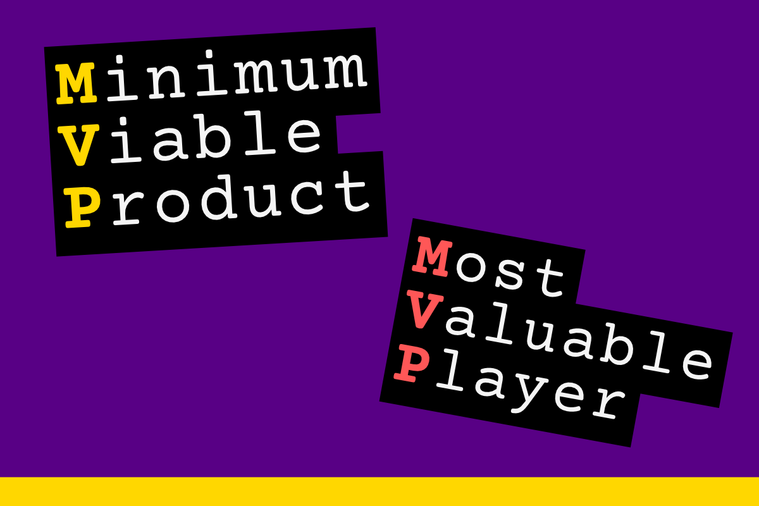
An MVP (minimum viable product) is the smallest version of a product that lets real users get real work done. Its job is learning: you find out whether your idea holds up before you spend the big budget.
In football, the MVP is the most valuable player on the field. In product development it's the opposite of an all-star lineup: as little as possible, but enough to win the game.
MVP meaning: where does the term come from?
The term is credited to Frank Robinson, who coined it in 2001 at his company SyncDev (Productboard (opens in new tab)). Eric Ries made it famous with his book "The Lean Startup" (2011). Ries describes the MVP as the version that lets a team learn the most about its customers with the least effort.
MVP vs prototype vs proof of concept
| Term | What question does it answer, and who uses it? |
|---|---|
| Proof of concept | Is this technically possible? Tested by the dev team. |
| Prototype | How does the solution feel? Tested by selected testers and decision-makers. |
| MVP | Do people actually use it day to day? Used by real users with real tasks. |
This is usually our order: in two working days together, we build a working prototype in 48 hours. It becomes an MVP once real users do their actual work with it.
Two famous MVP examples
Dropbox: Drew Houston didn't have a finished product when he showed in a video how Dropbox was supposed to work. According to Houston, the beta waiting list jumped from 5,000 to 75,000 sign-ups overnight (TechCrunch, October 2011 (opens in new tab)). The video proved the demand before the tech was ready.
Zappos: In 1999, Nick Swinmurn photographed shoes in San Francisco stores and put the photos online. When an order came in, he bought the pair at full price and shipped it himself (Fortune, September 2012 (opens in new tab)). There was no warehouse. He tested exactly one question: will people buy shoes online?
An MVP from our workshop
A client wanted their team to share one phone number and one WhatsApp number, without desk phones or work phones. We built an iOS app where calls and chats come together.
The first version did exactly two things: make calls and manage WhatsApp chats. We deliberately left out the CRM integration. First we needed to see that the team actually uses the app every day. A CRM integration for an app nobody opens is wasted work.
How the app is built is in the solution WhatsApp and phone calls in one iOS app.
Why an MVP changes more inside a company than expected
For many companies, the product isn't the deciding factor. It's seeing how fast results can happen. If you're used to IT projects showing something after months, you're now looking at a working solution after two days.
That does something to a team. Someone asks why approving a new tool takes three weeks. Or why the Excel list is still updated by hand. After an MVP, people question more things, and that's often a bigger win than the MVP itself.
Why MVPs fail
- Too many features. If the list is longer than one page, you're building version 1.0 on a smaller budget.
- No learning goal. Decide upfront which number or observation tells you whether to continue.
- The wrong testers. Colleagues are nice to you. You need people who actually have the problem.
- Too much polish. Weeks of design before you know whether anyone needs it.
Thought experiment: when the MVP says no
This example is made up. It shows what an honest no looks like.
Say your sales team wants a portal where dealers place orders themselves. Instead of building for six months, you give five dealers a simple form that emails every order to you. After four weeks, two order through it and three keep calling. That's not failure. You now know a portal alone won't fix it, and it took you four weeks instead of six months.
Are you ready for an MVP?
- You can describe the problem in one sentence without naming a solution.
- You know who has the problem, and you can reach five of them.
- You've decided what needs to happen within four weeks to keep going.
- You accept a no as a result.
Once the idea holds and it's clear you need your own solution, read on at custom software instead of off-the-shelf tools.
Robert
Frequently asked questions
MVP stands for minimum viable product. It's the first version of a product that does just enough for real users to use it in their daily work. The goal is to learn whether the idea holds up. In sports, MVP stands for most valuable player.
It depends on the scope. We build a working prototype in 48 hours, over two working days together. Turning it into an MVP with real users usually takes a few weeks, because feedback goes in and things like login or integrations get added.
We give you a price after a conversation and an effort estimate. The cost depends mostly on how many systems need connecting and whether you need an iOS or Android app. An MVP costs less than the full version because everything unnecessary stays out on purpose.
Further reading
MVP Development: Prototypes in 48 Hours
MVP development in 48 hours: we build your working prototype, whether web app, mobile app or integration. Two days together, and then it actually runs.
Custom Software Development, in Weeks
Custom software development without waiting months for the first version: when it pays off, how the prototype-first route works and who owns the code.
AI Hackathon: Real AI Solutions in 48 Hours
AI hackathon: why 48 hours of building together beats 12 months of AI strategy, and how we work with your team to ship real solutions fast.

Quarterback
Consultant, doer, brutally honest since 2005. ADHD. When something is broken, I want to fix it. But first I want to understand why. Quarterback at MacNorris.
IF YOU'RE NODDING RIGHT NOW, WE SHOULD TALK.
We enjoy honest conversations with people who have real problems. Whether anything comes of it is beside the point. We don't have time to chase you with calls for weeks afterwards anyway ☺️.